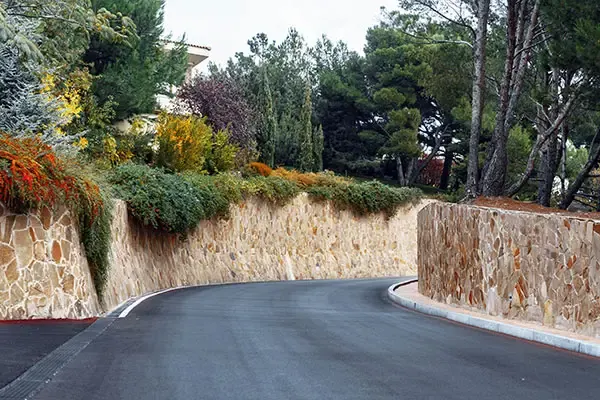
Different ground up the scarp
Most of Perth sits on sand, but the hills do not. Along the Darling Scarp and the plateau behind it, through Kalamunda, Lesmurdie, Gooseberry Hill, Forrestfield's upper slopes, Darlington, Glen Forrest, Mundaring, Roleystone and Kelmscott's hills, the ground is mostly lateritic gravel and clay over granite. Large boulders are common, and many blocks are steep.
That changes the job. Excavation can be slow and noisy where rock is close to the surface. Clay holds water rather than letting it drain away. And on a slope, every heavy rain sends water across the surface towards the nearest wall.
Slope and runoff
In the hills, the biggest threat to a retaining wall is water running down the slope. A wall that blocks surface runoff becomes a dam unless the water is caught and moved. Good designs usually:
- Intercept surface water with a dish drain, swale or spoon drain above the wall
- Include a drainage layer and slotted pipe behind the wall
- Discharge collected water to a point that will not cause erosion or flood a neighbour
- Avoid directing roof or driveway water into the ground directly behind the wall
If a quote does not explain where the water goes, ask.
Driveways and house pads
Many hills homes sit on a cut-and-fill pad with a steep driveway, and walls along driveways and below house pads carry significant loads. These are the walls most likely to need engineering and a building permit. An engineered block or reinforced masonry wall, or limestone or stone built to an engineer's design, is common for these jobs.
Stone and the hills look
Natural stone suits the bushland setting of the hills well, and many older properties have dry-stacked stone or rock walls. For lower garden walls, limestone blends in reasonably well, while some owners prefer to use granite rocks from their own excavation for a more natural look. Taller walls can be faced in stone over a reinforced core.
Bushfire-prone land
Much of the Perth Hills is designated bushfire-prone. If your property has a bushfire attack level assessment or is in a designated area, check whether that affects your choice of materials near the house. Timber sleepers are combustible; masonry and steel are not. Your local government can tell you what applies to your site.
Old walls on hills blocks
Older hills properties often have walls that were built informally, from rock or timber, without drainage. Those walls commonly show their age as bulging, timber rot, or soil washing through after storms. Our repairs page explains how builders usually decide between fixing and rebuilding.
Talk to us about your hills block
Call 08 7666 2963 or use the form. Tell us the suburb, the slope, what is above and below the wall and what access is like. A local builder will look at the site and give you a written quote. Approvals are covered in our council guide, and the cost guide has planning ranges.